The Barbican is pleased to announce a major retrospective recognizing the extraordinary career of American painter Robert Ryman (1930—2019). Robert Ryman: The Real Thing is the first significant exhibition in the UK to explore Ryman’s work in over 30 years and is a key highlight of the Barbican’s Autumn 2026 season.
Ryman (b. 1930 Nashville, Tennessee) moved to New York in 1952 and initially trained as a musician intending to pursue a career as a jazz saxophonist, before dedicating his life to painting. Robert Ryman:The Real Thing features over sixty works spanning his prolific career, from some of his earliest pieces from the mid-1950s to final works in the 2000s. For almost sixty years, he explored – and questioned – what constitutes a painting, variously playing around with how paint is applied to surface, set in relationship to the wall and exhibited in space.
Painting the paint
Ryman playfully and rigorously investigated materials and their effects, creating subtle and surprising paintings that show and make visible materials as they are. While Ryman mostly used white paint and a square format, this exhibition reveals the remarkable variety of works Ryman produced as he tested different paints and surfaces, working with oil, acrylic, enamel, and epoxy across cotton and linen canvas, fibreglass, steel, aluminium, Plexiglas, tracing paper, and coffee filter paper.
For Ryman, every painting was a test to ‘see what would happen’ as he experimented with materials and the paintings’ interactions with each other and their surroundings. Arranged thematically, with sections of work revealing different artistic approaches, Robert Ryman:The Real Thing celebrates Ryman’s legacy as a painter who moved beyond the categories of representation and abstraction, instead choosing to ‘paint the paint’ as a ‘realist’.
The Ryman experience
At the heart of the exhibition is ‘the Ryman experience’, a section featuring varied works from the 1950s – 2000s. As a former musician, Ryman often compared the sensation of looking at his paintings to listening to music, believing that both were best ‘understood’ through direct and immediate experience, rather than through intellectual analysis. For Ryman, the meaning of the painting resided in the encounter itself: its capacity to create a sense of delight, wellbeing and fulfilment. As he reflected: ‘It’s like listening to music. Like going to an opera and coming out of it and feeling fulfilled – that what you experienced was extraordinary. It sustained you for a while.’ Ryman maintained that his work needed to be experienced in person – ‘the real thing… was the only way to do it’.
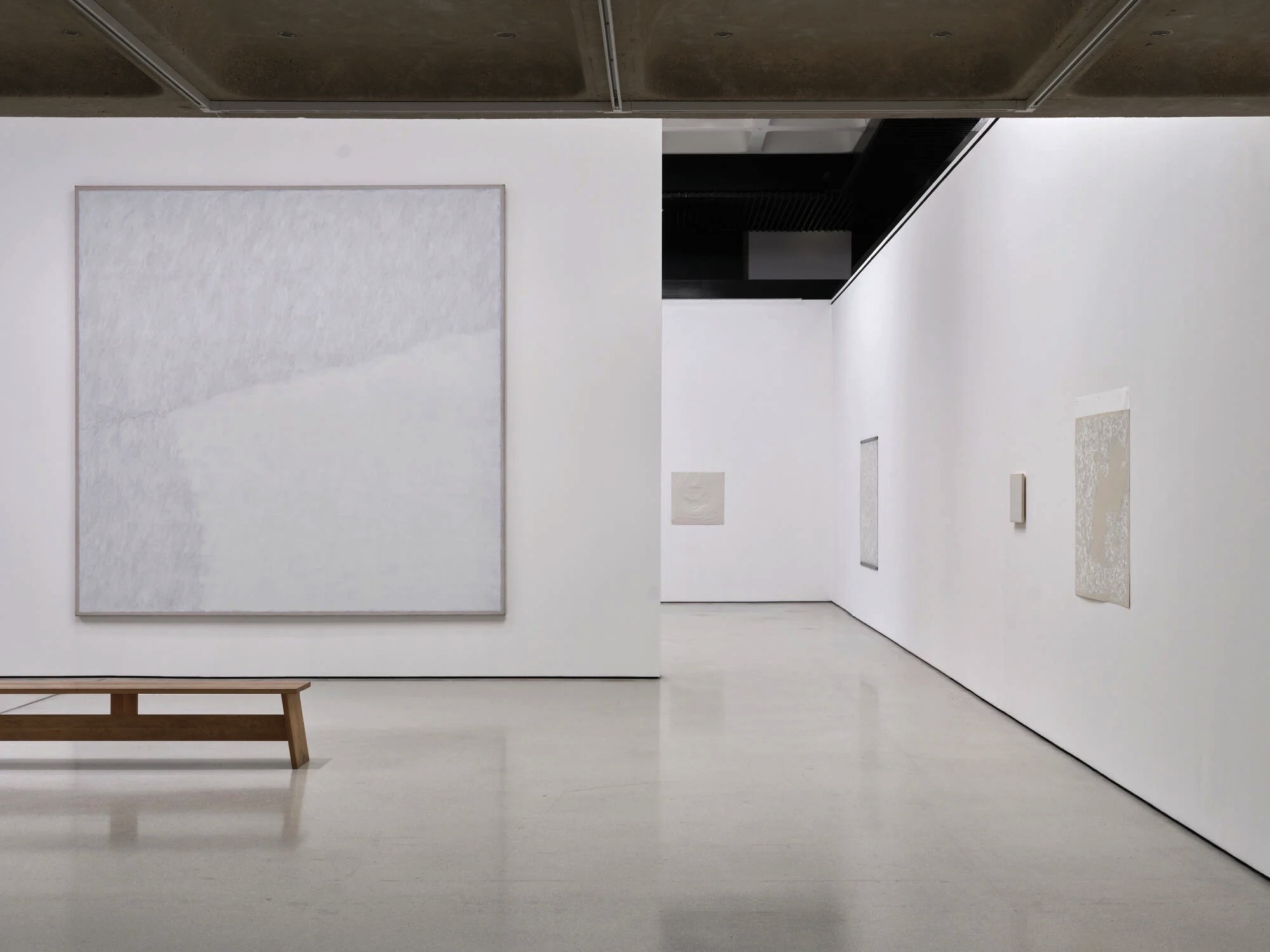
The ‘Ryman experience’ replicates Ryman’s preferences: groups of works from different periods, shown without anything extraneous to the work that could distract from its perceptible effects. The installation will be hung according to visual relationships created through variances in scale, gesture, materials, supports and effects, presented without any wall text or interpretation. Visitors are invited to pay close attention to subtlety, nuance, and visual complexity when viewing the works’ similarities and differences.
On display in London for the first time since 1993 and central to ‘the Ryman experience’ is one of Ryman’s largest works, Surface Veil II, ca. 1970. Measuring 12’x 12’ (or 3.65 x 3.65 metres), the work was so large that Ryman painted it, unstretched, on his studio floor. Along the edges of the canvas, he drew a large square in blue chalk to demarcate the area in which to paint. Horizontal ‘bands’ of vertical strokes that vary in translucency and opacity reveal both the limit of the length of his arm and the viscosity of the paint as he pulled it along the surface.
© Text and Image Courtesy of Barbican Center