This autumn in London, Lisson is honoured to present an exhibition of one of the world’s foremost abstract painters, Ha Chong-Hyun, surveying his experimentation and mastery over the past six decades of pioneering work. The Korean artist’s inaugural show with the gallery and his first in London since 2020 amounts to a wide-ranging yet succinct survey of Ha’s practice from some of his earliest extant works up to the present day.
The display begins with a geometric composition featuring woven, painted strips from the early Naissance series and an equally colourful folded and rippled canvas, dating to the late 1960s. These both signify his early positioning of painting firmly within the realm of objecthood – exploring it three-dimensionally and in the round – although he never claimed them as sculptural in intent, preferring to simply question where the painting’s surfaces and supports might really begin and end. Further pushing the possibilities of material and action within the now contested field of painting, Ha began burning his impasto surfaces and adding coiled springs or barbed wire directly to works made in the 1970s, reflecting South Korea’s protracted periods of martial law and military dictatorship, as well as the paucity of materials available to artists at the time.
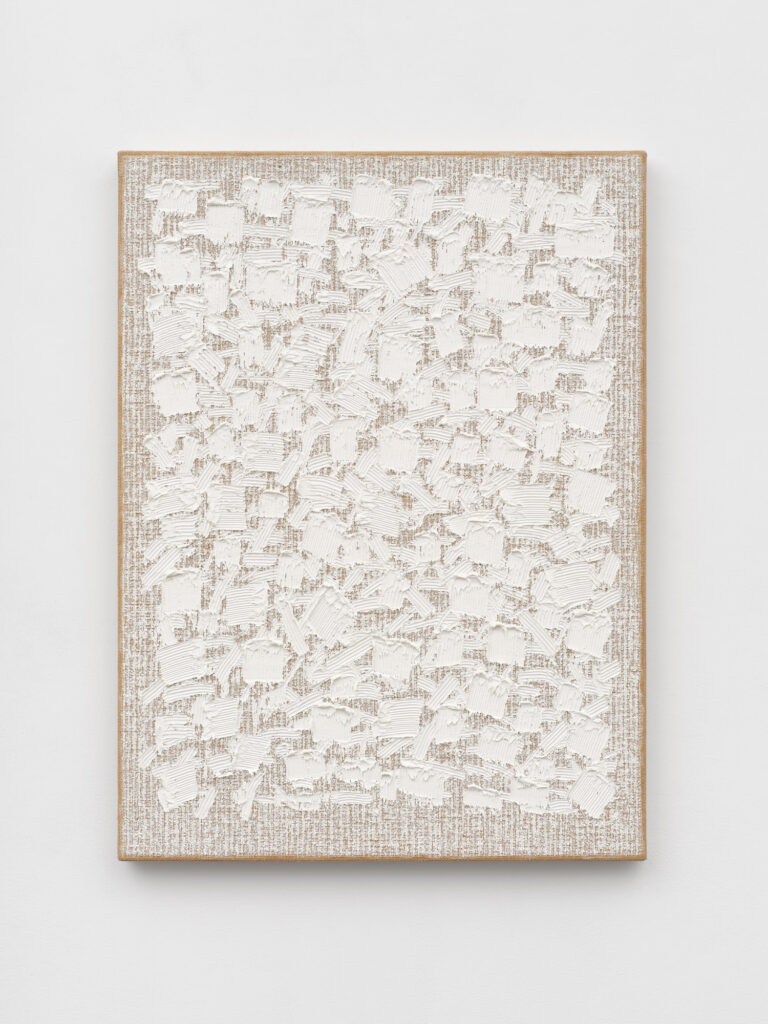
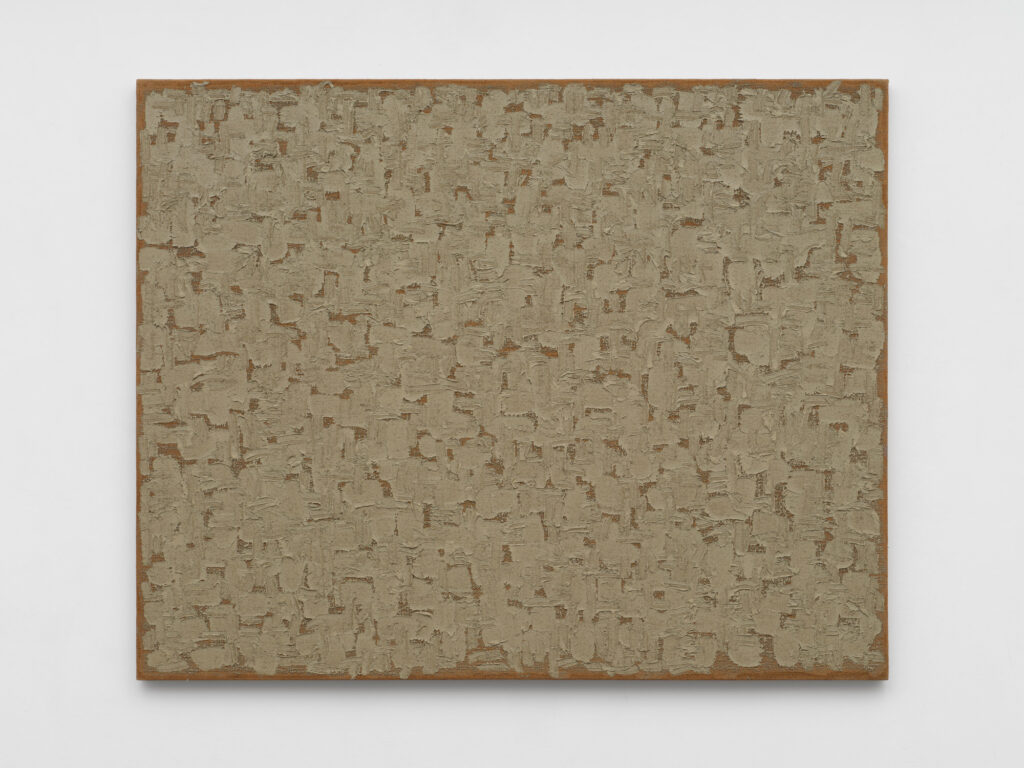
At the beginning of the 1970s, Ha alighted upon his signature method of pushing paint through the reverse of coarse hemp canvas – literally turning the painting process inside out. Rather than applying paint onto an image plane, Ha forces pigment through the woven structure of the canvas, allowing pressure and material resistance to shape the final form. The resulting surface is determined less by expressive mark-making than by compression and persistence. This innovation, known collectively as the Conjunction series, continues to this day, with an array of different textures, gestures, tones and techniques that also vary in terms of orientation from vertical and horizontal, to perpendicular, radiant and freeform in gesture.
Over subsequent years, Ha has expanded and refined this inquiry, showing a sustained commitment to experimentation that has significantly shaped broader discussions of postwar abstraction. In the 2000s, his practice evolved into what has been described as the Post Conjunction series, extending his exploration of colour, scale, and spatial rhythm while maintaining the foundational principle of pressure and surface.
© Ha Chong-Hyun; Courtesy Lisson Gallery