It never ceases to amaze me how much Constantin Brâncuși’s sculptures draw me in. Their radical reduction to the essential, the clarity of their forms, and the tranquility they convey continue to fascinate me. Brâncuși freed sculpture from everything superfluous. He was not interested in mere representation but in the essence of a form – and this is precisely where his significance as one of the most important pioneers of modern sculpture lies.
From March 20 to August 9, 2026, the Neue Nationalgalerie in Berlin presents a large-scale retrospective dedicated to the Romanian-French artist in cooperation with the Centre Pompidou in Paris. With over 150 works, it is the first comprehensive exhibition of Brâncuși’s work in Germany in more than fifty years. The fact that it is being shown in Berlin is due to the Centre Pompidou’s major renovation.
On a sunny Tuesday morning, I enter the upper hall of the Neue Nationalgalerie – one of my favorite buildings in the city. A large “Brancusi” sign announces the exhibition. Right at the entrance, I am greeted by Brâncuși’s Sleeping Muse from 1910. I look around and can take in almost the entire hall at a glance. Anyone familiar with the Neue Nationalgalerie knows the presence of this place. Mies van der Rohe’s architecture is radically open, minimalist, monumental. It is both stage and protagonist. The openness of the space certainly has its charm; many of the sculptures can be walked around, visible chisel marks on the back of some works make them incredibly tangible, light and perspective constantly alter their appearance.
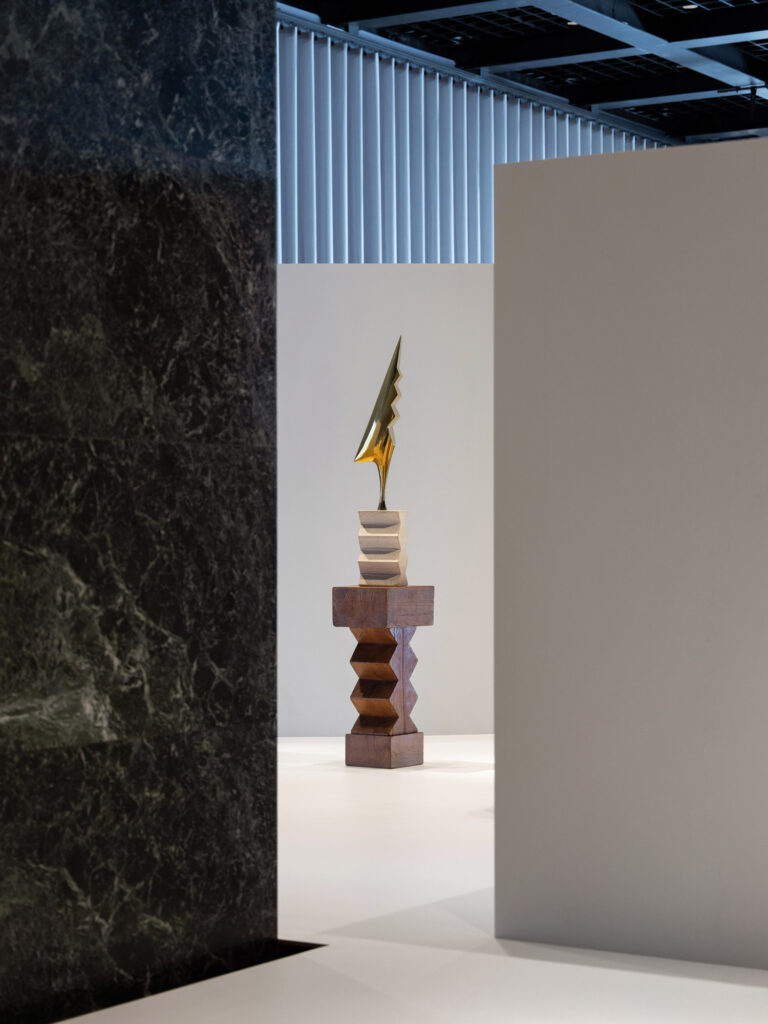
Nevertheless, I cannot shake the feeling that some of the works have to hold their own in this vast space. Brâncuși’s sculptures unfold their power especially in relation to one another, in finely balanced spatial relationships. The monumental marble columns, the expanse of the hall, and the sparingly used partition walls do give the space some structure, but for me they do not create a clear spatial guidance. As a result, some works seem almost lost – more placed than staged. This difference is particularly noticeable to me when compared to the major retrospective at the Centre Pompidou in 2024 – and most recently to the presentation at the H’ART Museum in Amsterdam. There, Brâncuși’s work appeared precisely choreographed, each piece part of a carefully conceived spatial arrangement.
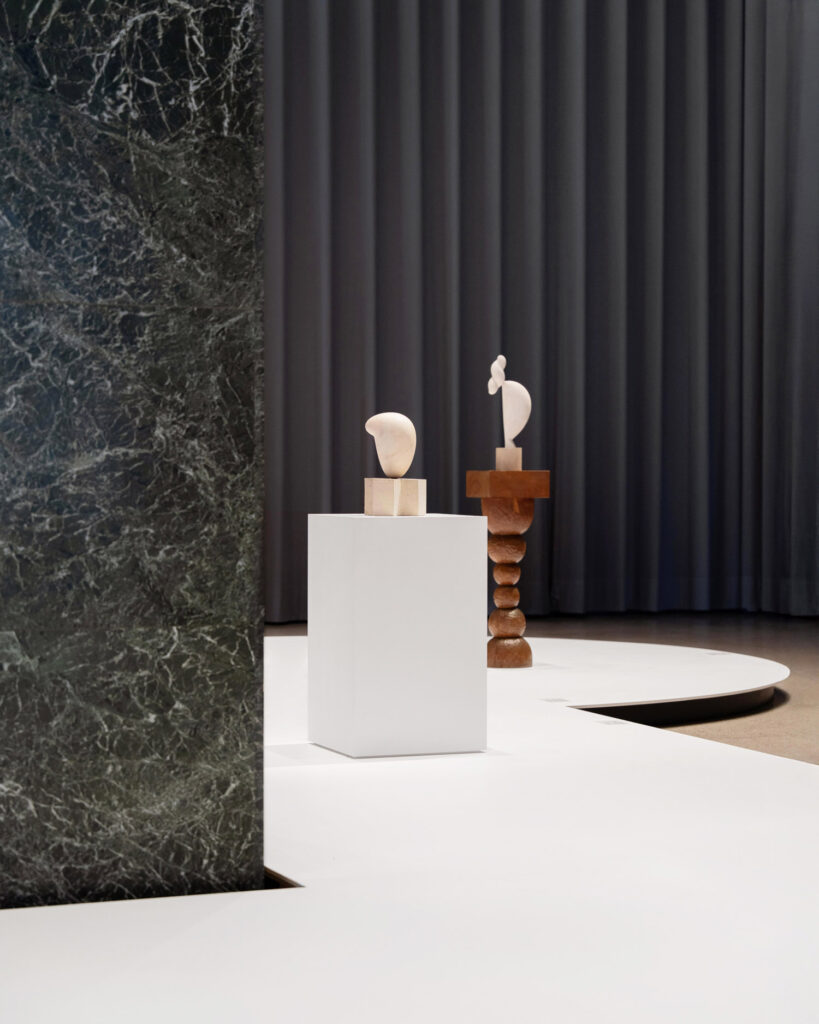
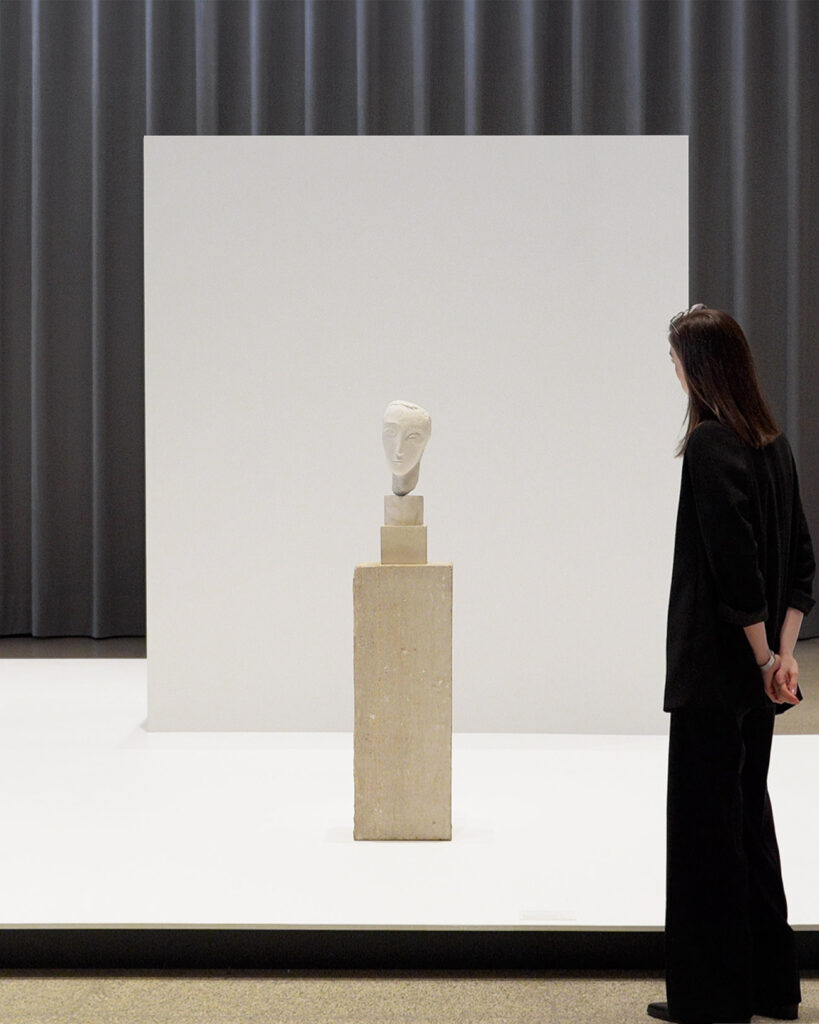
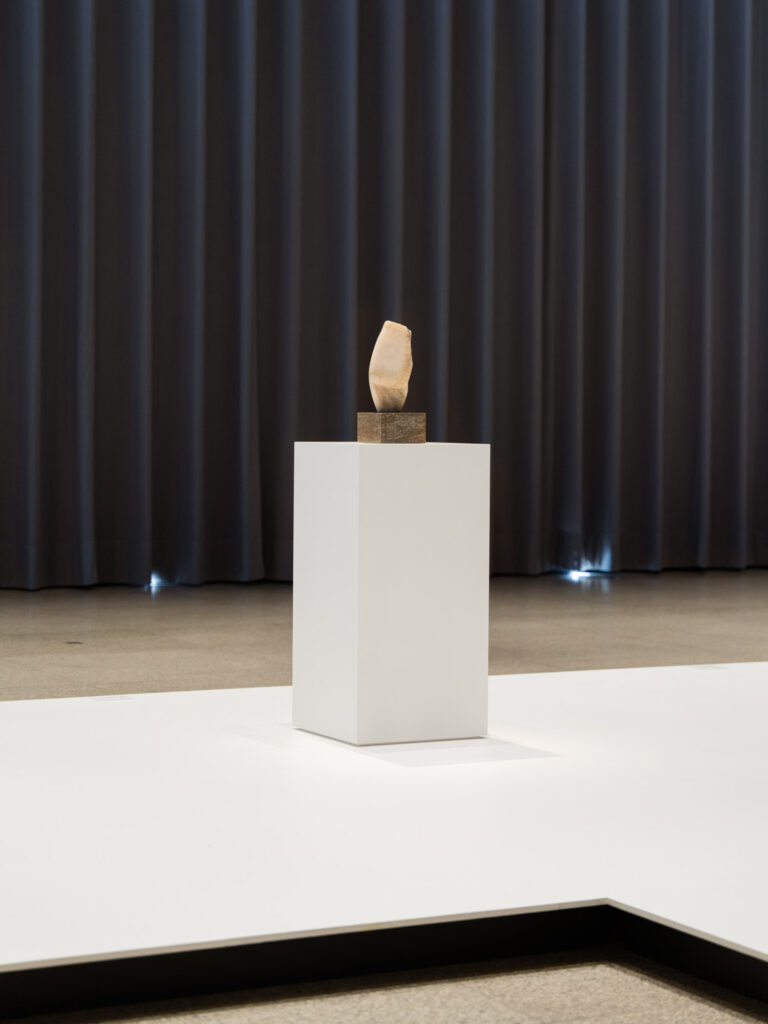
Yet, encountering Brâncuși’s work remains deeply impressive. Polished surfaces reflect their surroundings so that form and space seem almost to dissolve into one another. Some of the sculptures appear so light and graceful that they seem to float. In contrast, the works in wood feel heavy, grounded, archaic, and quiet. They do not impose themselves – they ask for closeness and attention. Brâncuși’s sculptures possess a strong tactile quality; I want to step closer and touch their surfaces. His torso works, in particular, continue to fascinate me. For Brâncuși, the torso was not simply a part of the body but an autonomous fragment. From 1909 onward, he began to experiment with the motif of the female body. While the torso still appears as an expression of movement and incompleteness in the work of his former mentor Auguste Rodin, it becomes the essence in Brâncuși’s work. This reduction gives rise to a distinctive ambivalence: the form appears at once concrete and abstract, approachable and yet distant.
I appreciate the thematic structure of the exhibition. It illustrates how consistently Brâncuși varied and developed individual motifs over the years. Groups of works such as The Kiss, Bird, or the variations on the Sleeping Muse and Sleeping Child are not finished works, but stages in an ongoing process of approximation. Each iteration is a condensation, a further reduction, a step closer to what he understood as the “essence of things.” A look at his studio reveals just how central the spatial relationship of his works was to him. In 1916, Brâncuși moved to Impasse Ronsin, an artists’ colony in Paris, and began to conceive of his studio as a total work of art. He repeatedly rearranged his works in the space into so-called groupes mobiles (mobile groups), seeking the perfect balance of form, distance, and light. Pedestals were not merely supports but an integral part of the works. If a work was sold, he replaced it with corresponding plaster or bronze models to preserve the spatial unity of the studio.
This makes the section of the Berlin exhibition featuring the partial reconstruction of that studio all the more impressive. In a dimly lit, almost intimate space, photographs and film footage come together to offer a focused glimpse into Brâncuși’s life and work. The brightly lit studio reconstruction in the center of this area serves as a serene counterpoint to the open expanse of the rest of the hall. Numerous tools hang densely arranged on the walls, and a film featuring old archival footage from his studio plays. Here, one can sense just how much Brâncuși understood his sculptures as spatial structures—and how deeply their impact relies on concentration.
It is always a special experience for me to encounter his works. Constantin Brâncuși is rightly considered one of the most important pioneers of modern sculpture. His works still show how timeless and universal reduction can be. Their power unfolds in Berlin – even where Mies van der Rohe’s open architecture does not always provide the ideal setting. Nevertheless, the Berlin retrospective is an impressive (first) encounter with Brâncuși’s work.
The exhibition runs through August 9, 2026, at the Neue Nationalgalerie in Berlin.